
SWOT Analysis Template
Fill in the four boxes — strengths, weaknesses, opportunities and threats — using the prompts, rank the items that matter most, and the builder turns them into a printable SWOT matrix and a TOWS grid that pairs internal factors with external ones to suggest strategies. Use it for a business, a product, a project, a school assignment or your own career.
- Free to use
- No sign-up
- Runs in your browser
SWOT builder
Put the most important item first in each box — the TOWS grid pairs the top items.
Prompts to get started
SWOT & Strategy Template Pack
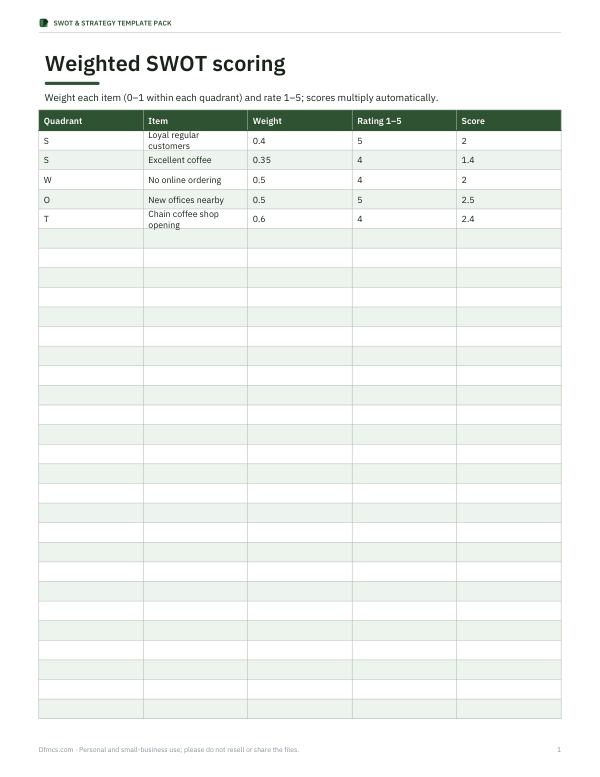
Formatted SWOT matrix templates (Word, PDF), a TOWS strategy worksheet, a weighted SWOT scoring workbook (Excel), a personal SWOT worksheet and a PESTLE prompt sheet.
- SWOT matrix (DOCX/PDF)
- TOWS worksheet (DOCX, PDF)
- Weighted SWOT (XLSX)
- Personal SWOT (DOCX, PDF)
- PESTLE prompts (PDF)
Formats: DOCX, PDF, XLSX. Instant download after payment (link valid 72 hours, up to 5 downloads). AI-assisted: the templates were drafted with AI help and reviewed and laid out before publishing.
$5.00 USD, one-time 5 files · about $1.00 each
- Instant download
- 7-day refund
- Secure checkout by Stripe
7-day money-back guarantee. Full refund within 7 days of purchase, even after you download.
Free sample: PESTLE Prompts (PDF, 63 KB)
Full refund within 7 days — see the refund policy and license.
Free printables
Single sheets you can print right now, no sign-up. The full pack adds every sheet in one download plus the editable files.
 Printable Personal SWOT Worksheet
 Printable PESTLE Prompts Sheet
What a SWOT analysis is
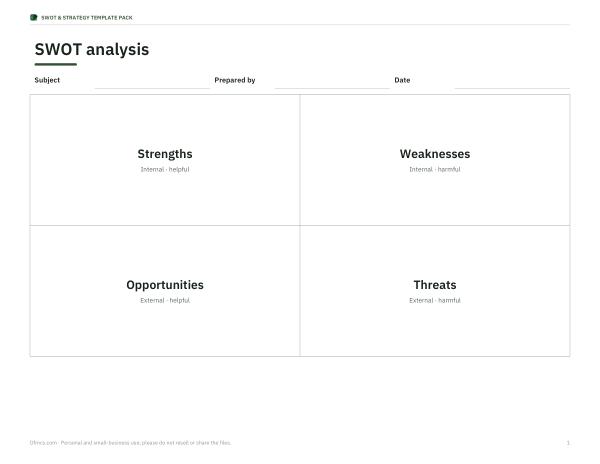
SWOT stands for Strengths, Weaknesses, Opportunities and Threats. It is a simple planning framework that looks inward at what an organisation — or a person, product or project — does well and badly, and outward at what is happening around it. Strengths and weaknesses are internal and largely within your control; opportunities and threats are external and have to be responded to. Laid out in a two-by-two grid, a SWOT gives a quick, shared picture of where you stand before making decisions.
The SWOT grid
| Helpful | Harmful | |
|---|---|---|
| Internal (you control) | Strengths | Weaknesses |
| External (the environment) | Opportunities | Threats |
A common mistake is putting external factors in strengths or weaknesses. “A growing market” is an opportunity, not a strength; “our team lacks sales experience” is a weakness, not a threat.
How to do a SWOT analysis
- Define the subject and the decision it supports — “Should we open a second café?” gives better answers than a general review.
- Gather facts: sales, customer feedback, competitor information, market trends.
- Brainstorm each quadrant with a mix of people; aim for quantity first.
- Make items specific and evidence-based: “Average review 4.8/5 from 600 reviews” beats “good reputation”.
- Rank the items in each box by importance and keep the top three to seven.
- Turn the analysis into strategy with the TOWS grid.
- Set actions, owners and dates — a SWOT that stays in a drawer changes nothing.
From SWOT to strategy: the TOWS matrix
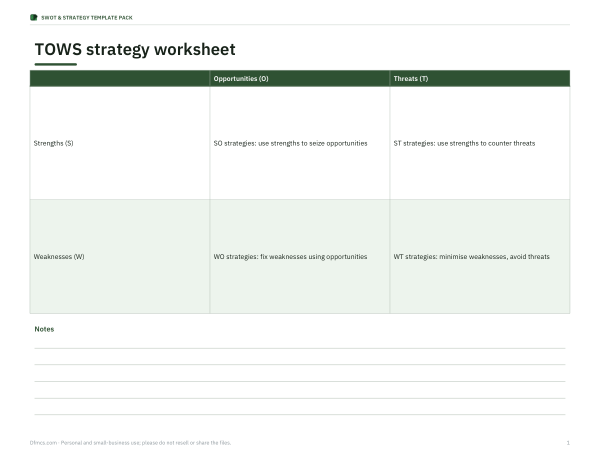
A SWOT describes a situation; the TOWS matrix turns it into options by pairing internal and external factors. SO strategies use strengths to seize opportunities (a café known for its pastries launches office catering for the new business park). ST strategies use strengths to reduce threats (loyalty rewards for regulars before the chain opens). WO strategies overcome weaknesses by taking advantage of opportunities (adding online ordering to capture office lunch trade). WT strategies minimise weaknesses and avoid threats (a smaller winter menu to cut costs during road works). The builder pairs the top-ranked items in each box as a starting point for discussion.
Worked example: a riverside café
The default example in the builder shows a café with loyal customers, great coffee and a riverside location, but a small kitchen, no online ordering and quiet winters. Offices opening nearby and a summer food festival are opportunities; a chain coffee shop, rising costs and road works are threats. The TOWS grid suggests using loyal customers to win the new office trade, defending against the chain with the quality of the coffee, adding online ordering for the office market, and planning a lean winter menu around the road works. Each suggestion becomes a project with an owner and a deadline.
SWOT for students and careers
- School and university assignments — analyse a company from its annual report and news coverage; cite your sources for each item.
- Personal SWOT — strengths might be skills and qualifications, weaknesses gaps in experience, opportunities growing fields or training schemes, threats automation or competition for roles.
- Job interviews — a quick personal SWOT helps answer “What are your strengths and weaknesses?” with examples.
- Start-ups — a SWOT alongside customer research helps decide whether an idea is worth pursuing.
Common SWOT mistakes
- Vague items such as “good team” or “the economy”.
- Mixing internal and external factors.
- Long unranked lists with dozens of items.
- Only listing positives — honest weaknesses are the most useful part.
- Doing it once and never revisiting it; markets change.
- Stopping at the grid instead of turning it into actions.
SWOT vs PEST and Porter’s Five Forces
PEST (or PESTLE) analysis looks only at the external environment — political, economic, social, technological, legal and environmental factors — and is a good way to find opportunities and threats. Porter’s Five Forces analyses the competitive pressure in an industry. Many planners use PESTLE and Five Forces first, then summarise the findings in a SWOT alongside an honest look at internal strengths and weaknesses.
Presenting your SWOT
Keep the grid to one page, use short bullet points, and put the most important item at the top of each box. In reports and presentations, follow the grid with the three or four strategies you recommend and the evidence behind them. The print button produces a clean one-page grid and TOWS table; the paid pack adds formatted Word, PDF and Excel templates including a weighted SWOT scoring sheet.
Making each item useful
Good SWOT items are specific, evidence-based and relevant to the decision. Instead of “strong brand”, write “recognised by 62% of local survey respondents”; instead of “competition”, write “national chain opening 200 metres away in March”. If an item would not change any decision, leave it out. Where possible, note the source — customer reviews, sales data, a news article — so others can check it.
Privacy
Your SWOT stays in your browser. Nothing you type is uploaded or stored.
Frequently asked questions
What does SWOT stand for?
Strengths, Weaknesses, Opportunities and Threats.
What is the difference between strengths and opportunities?
Strengths are internal and within your control; opportunities are external conditions you can take advantage of.
How many items should each box have?
Usually three to seven of the most important, ranked.
What is a TOWS matrix?
A grid that pairs strengths and weaknesses with opportunities and threats to generate strategies.
Can I do a personal SWOT?
Yes, it works well for career planning and interview preparation.
Is my data stored?
No, the builder runs entirely in your browser.